

Stock
People usually have significantly more money in stocks than they have in cash. How can that benefit your nonprofit?
When people sell their stock, they’re going to lose at least 15 to 20% in capital gains taxes. Alternatively, if they were to gift that stock to charity, they would receive a tax deduction on the total value of the stock and avoid all the capital gains taxes. This results in a financial win/win situation for both the charity who receives the funds and the donor who receives the tax deduction.
Here is a hypothetical example for illustrative purposes only that you can share with your donors to help explain this.
Meet Bill, your loyal donor. Let's say that Bill has $10,000 in cash and $10,000 worth of Apple stock. Bill wants to donate $10,000 to his favorite charitable organization, but he also has his son’s college tuition payment coming up that will be $10,000. Bill goes to his financial professional and asks him what is a potential way to accomplish these things from a tax standpoint?
First, the financial professional says, let’s look at the stock because there are two potential tax issues when gifting stock: the capital gains tax on the gained value in the stock and the tax deduction created by the gift of the stock to a nonprofit.
Capital Gains Issue
First, let’s address the capital gains tax issue. There are two options for Bill with his stock, (1) he could sell the stock and donate the proceeds directly to the charity, or (2) he could donate the stock directly to the charity. Bill has $10,000 in Apple stock that he purchased for $2,000, the $2,000 would be considered his tax basis. Bill has a 20% capital gains tax rate. In the first option, by selling the stock, Bill would incur a 20% capital gains tax on the $8,000 appreciation of stock resulting in $1,600 of taxes. In the second option, by donating the stock directly to the charity, he would not incur any capital gains tax. In the first option, only $8,400 goes to the charity due to the capital gains tax, in the second option $10,000 goes to the charity because there is no capital gains tax.
Tax Deduction Issue
Secondly, let’s address the tax deduction issue. Bill is in the 40% combined state and federal tax bracket.
There are tax deduction opportunities for Bill with these two options. If Bill selects option one and sells the stock, he would only be able to take a tax deduction on the $8,400 he gifted to the charity, resulting in a tax savings of $3,360. In the second option, by donating the stock directly to the charity, he would be able to take a tax deduction on the full $10,000 of stock, giving him a tax savings of $4,000. (The chart below shows how you arrive at these numbers.)
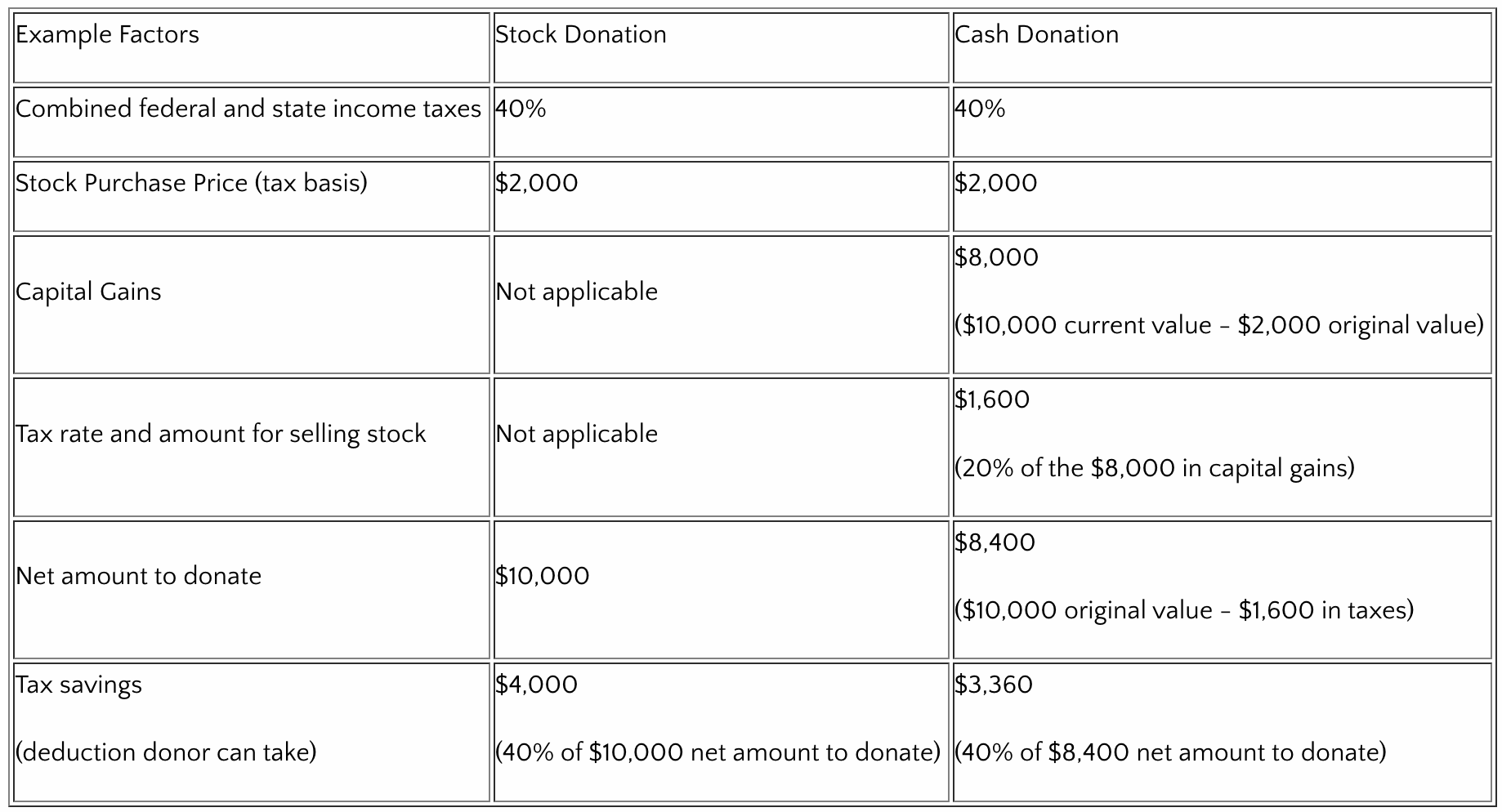
Bill sees how advantageous donating the stock to charity is for him compared to selling the stock because none of the $10,000 stock value goes to waste. It all goes to charity and he gets a larger tax deduction and thus a larger tax savings. However, Bill is still left with his son’s tuition bill of $10,000. Now Bill can use his $10,000 in savings to pay the college tuition, meanwhile the charity is still getting $10,000 and Bill is getting his $4,000 tax savings by donating the stock to charity instead of cashing it in first and then gifting it.
For further understanding on this topic and additional ways this strategy might work for your donor and your nonprofit contact Bill Eckert, Senior Financial Advisor, at (913) 322-9177.
This example is hypothetical only, and does not represent the actual performance of any particular investments. Investments in securities do not offer a fixed rate of return. Principal, yield and/or share price will fluctuate with changes in market conditions and when sold or redeemed, you may receive more or less than originally invested.
Financial Professionals do not provide specific tax/legal advice and this information should not be considered as such. You should always consult your tax/legal advisor regarding your own specific tax/legal situation. Neither Cetera Advisor Networks LLC nor any of its representatives may give legal or tax advice.